Lessons · Maths
How do you solve a quadratic equation?
A lesson drawn by Saitama, the AI tutor that teaches on a whiteboard.
The explanation
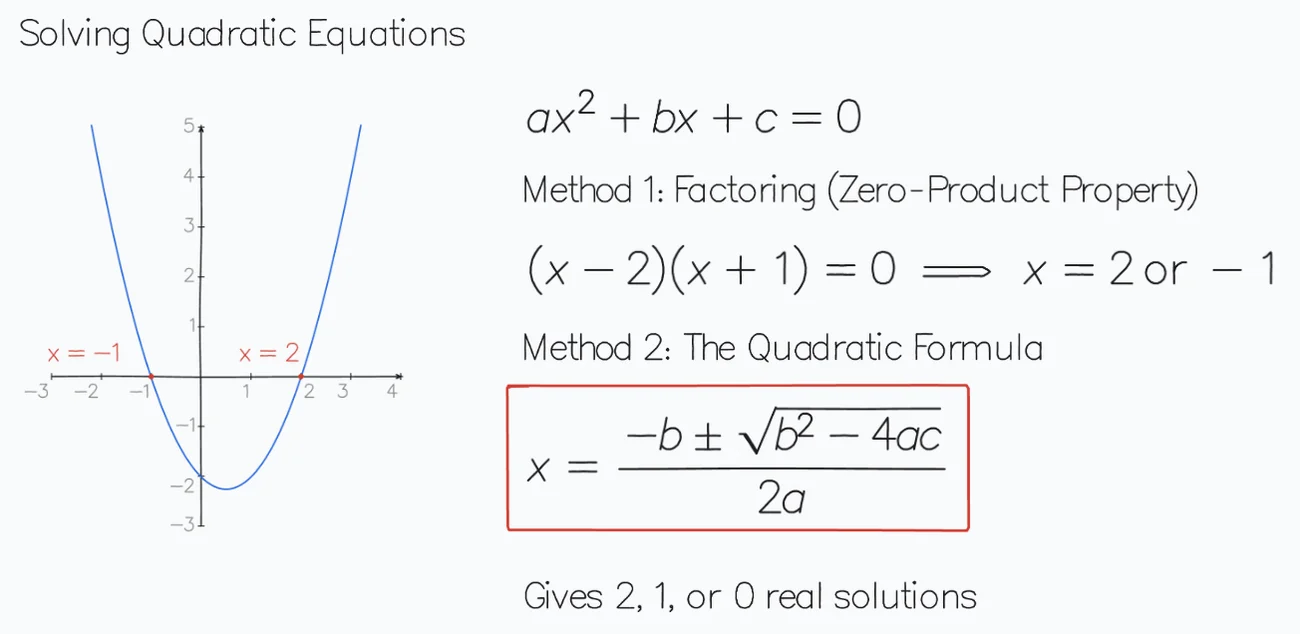
A quadratic equation is any equation where the highest power of x is x squared. When you graph one, it forms a curved bowl called a parabola, and solving it means finding where that curve crosses the horizontal axis.
Here is the curve for x squared minus x minus two. You can see it dips below the axis and comes back up, cutting across at negative one and positive two. Those crossing points are our solutions, where the whole expression equals zero.
Before doing any algebra, we gather all terms on one side so it equals zero. We call this standard form.
If the numbers work out nicely, the quickest route is factoring. If two numbers multiply to make zero, at least one of them has to be zero.
For our curve, x squared minus x minus two breaks into x minus two times x plus one. Setting each piece to zero gives x equals two or x equals negative one.
When factoring is tricky or impossible with whole numbers, we use the quadratic formula. It comes from completing the square and works on every quadratic equation without exception.
You read off a, b, and c from standard form and plug them straight in: x equals negative b, plus or minus the square root of b squared minus four a c, all over two a.
This single formula gives you every solution directly.
Depending on what is inside that square root, the curve might cross twice, touch the axis once, or never touch it at all, meaning two, one, or no real solutions.