Lessons · Physics
How does a battery power a light bulb?
A lesson drawn by Saitama, the AI tutor that teaches on a whiteboard.
The explanation
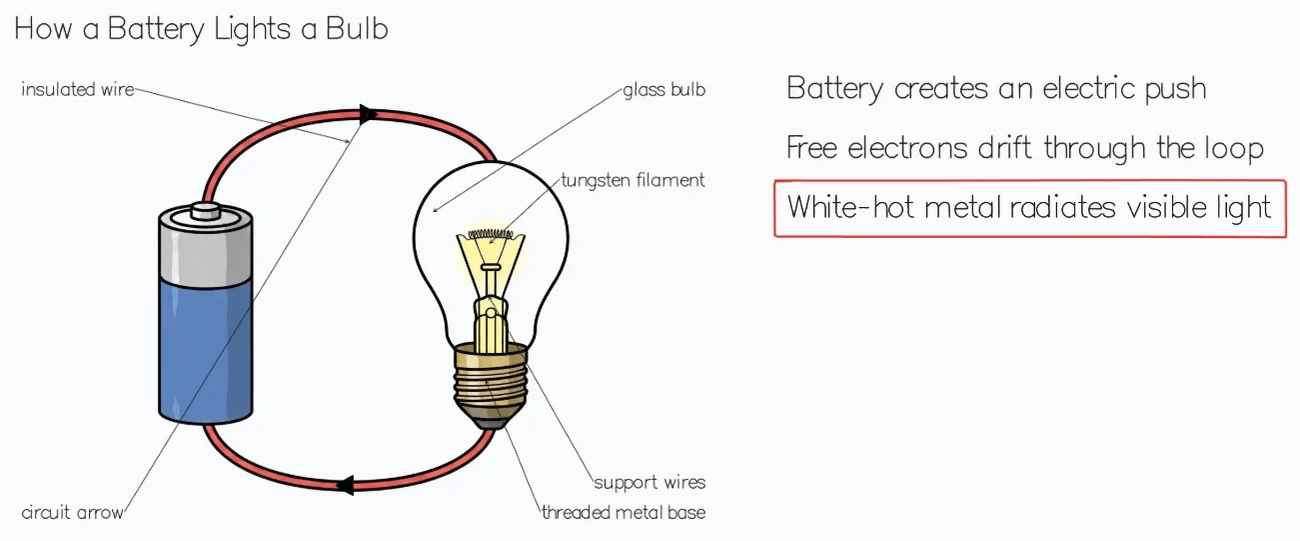
A battery doesn't dump electrons into an empty wire; the wire is already full of free electrons, and the battery acts like a pump that pushes them through a complete loop.
Inside the battery, chemical reactions push negative charge to one end and leave a deficit at the other. When we attach wires from both terminals to a light bulb, we create a closed path. An electric field spreads through the loop, nudging electrons everywhere along the wire to start drifting.
The chemical reactions inside the battery separate electrical charges, giving the negative terminal extra electrons and the positive terminal a shortage. This imbalance is what pushes electrons through the loop.
The copper wires are already packed with mobile electrons. The moment the connection closes, an electric field pushes them along together, drifting steadily through the whole loop.
The copper wire is wide and easy to pass through, but the bulb's tungsten filament is extremely narrow. That squeeze forces the drifting electrons to collide violently with the metal atoms, dumping energy and heating the metal up.
The filament gets so intensely hot—thousands of degrees—that it glows white-hot, radiating light in every direction.
So the battery provides the push, but the light comes from electrical energy turning into heat inside the filament until it glows.