Lessons · Economics
How does supply and demand set prices?
A lesson drawn by Saitama, the AI tutor that teaches on a whiteboard.
The explanation
Prices in a market are not chosen out of thin air by sellers. They settle through a tug of war between what buyers are willing to spend and what sellers are willing to provide.
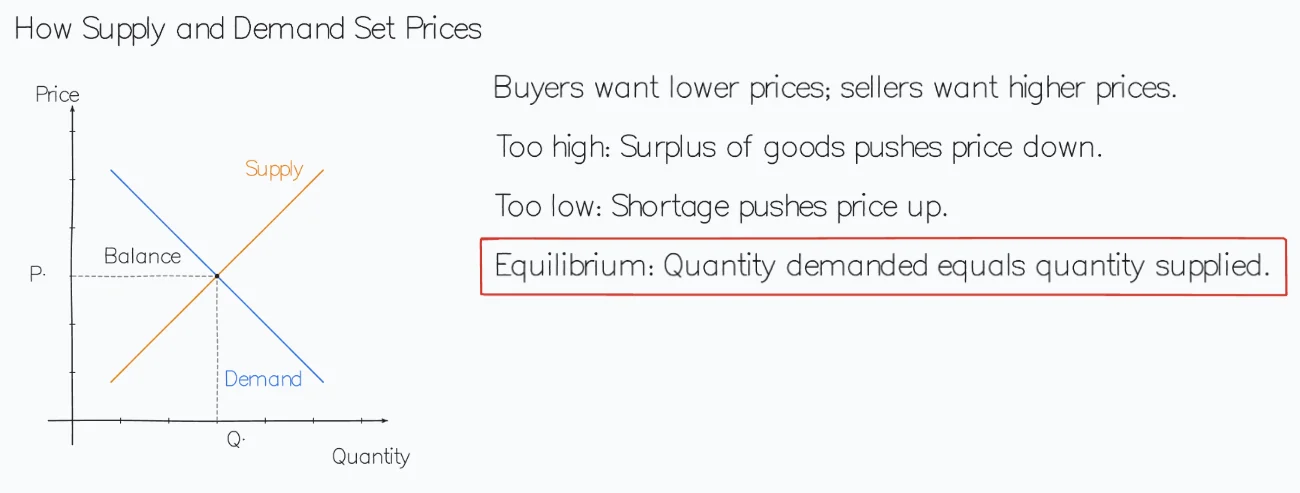
We can see this on a chart comparing the price of an item to the quantity people want to trade. The blue line is demand: when the price is high, fewer people buy, and when the price drops, people want more.
The orange line is supply. Sellers want to produce and offer more items only when they can get a higher price to cover their costs and make a profit.
Imagine sellers try to charge too much, above that crossing point. Few people buy, so shelves fill up with unsold goods. To avoid losing money on dead stock, sellers start cutting prices.
Now look at the opposite. If the price is set too low, shoppers rush in and buy up the stock quickly, but sellers cannot afford to supply enough. With buyers competing for scarce items, the price gets bid upward.
The price naturally gravitates toward the crossing point, called equilibrium. At this balance, the amount sellers produce exactly matches what buyers take home, discovered through trial and error.
That balance is the market price.