Lessons · Physics
Why do objects float or sink?
A lesson drawn by Saitama, the AI tutor that teaches on a whiteboard.
The explanation
Whether something floats or sinks does not depend on how heavy it is overall—a huge steel ship floats easily, while a tiny pebble drops straight to the bottom. It comes down to a contest between two forces.
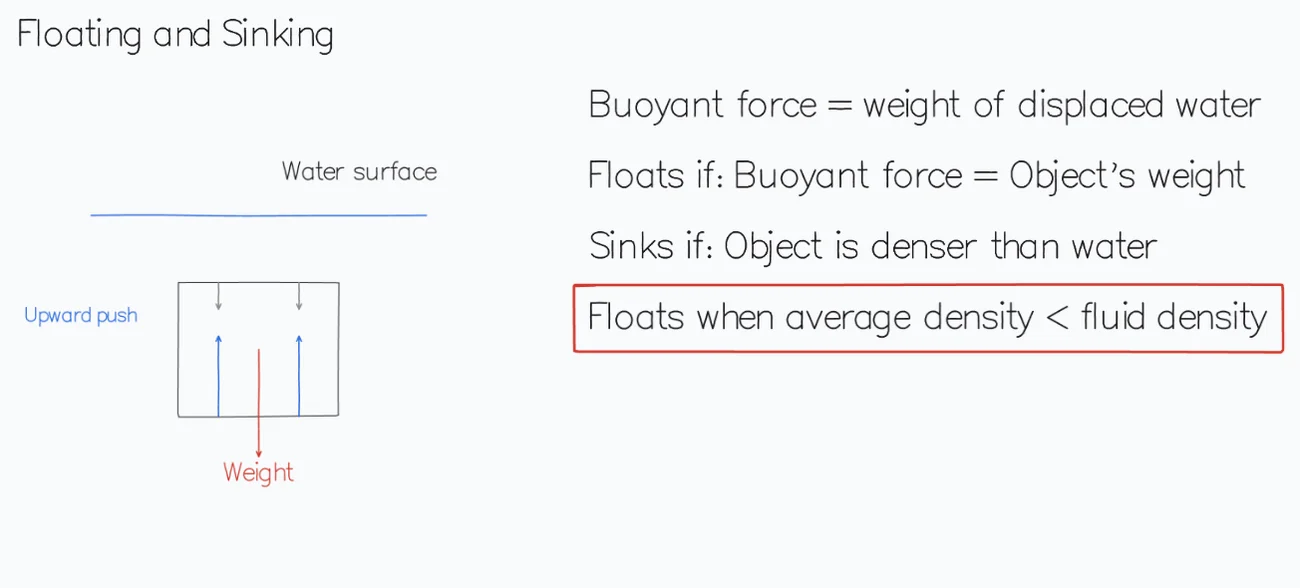
Imagine a block sitting underwater. Gravity pulls it down with the object's weight. At the same time, the water pushes inward on every side. Because water pressure increases as you go deeper, the water pushes up harder on the bottom than it pushes down on the top.
That net upward push from the water is called the buoyant force. When you put an object in water, it has to push aside—or displace—some water to make room for itself.
If the weight of the water pushed aside matches the entire weight of the object before it goes completely under, the upward push balances gravity, and the object floats.
If the object is packed with more mass for its volume than water—in other words, if its density is higher—even fully submerged it cannot push aside enough water weight to balance its own weight, so it sinks.
So the whole rule comes down to comparing densities: an object floats when its overall average density is less than the fluid around it.
Keep this rule in mind: shape lets a steel ship hollow out its body, lowering its average density below water, which is why shape and density decide floating, not weight alone.