Lessons · Physics
Why is the sky blue?
A lesson drawn by Saitama, the AI tutor that teaches on a whiteboard.
The explanation
Sunlight looks white or pale yellow to us, but it actually contains all the colours of the rainbow combined together.
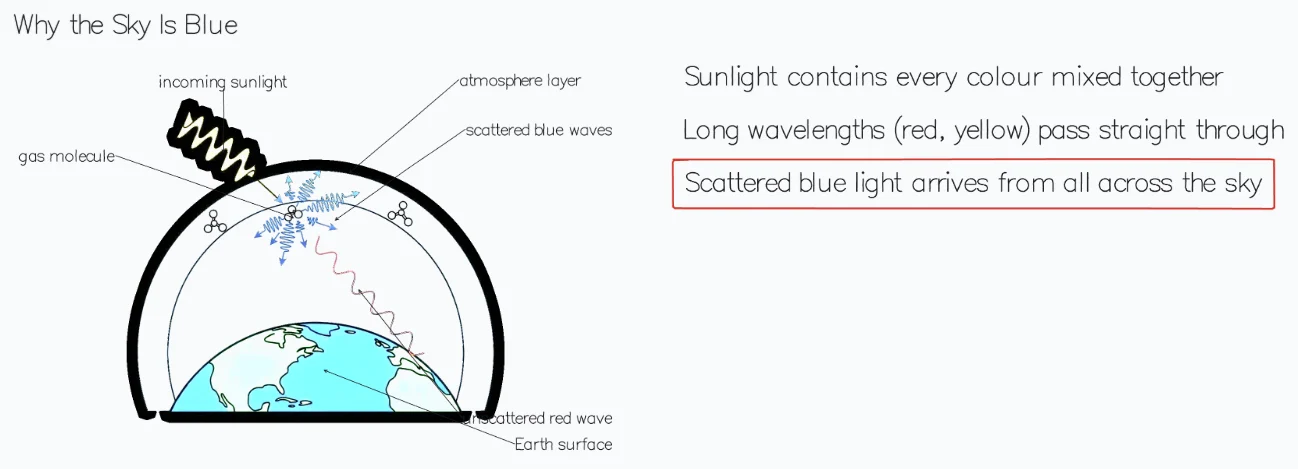
Light travels as waves. Red light travels in long, lazy waves, while blue light travels in much shorter, choppier waves. When this sunlight enters Earth's atmosphere, it runs into billions of tiny gas molecules, mostly nitrogen and oxygen.
White sunlight carries every colour, each with its own wavelength.
Because air molecules are so tiny, they barely disturb the longer red and orange waves, which pass right past them. But the short blue waves collide with these molecules and bounce off in every possible direction.
The longer waves keep travelling in a direct line from the Sun down to the ground.
Violet light actually scatters even more than blue, but sunlight contains much more blue light to begin with, and our eyes are far more sensitive to blue than to violet.
So whenever you look up away from the Sun, you are seeing that scattered blue light arriving at your eyes from every direction across the atmosphere.
That scattered blue light filling the entire air is what we see as the blue sky.