Lessons · Earth science
What causes ocean tides?
A lesson drawn by Saitama, the AI tutor that teaches on a whiteboard.
The explanation
The ocean rises and falls every day because the Moon's gravity pulls on different parts of Earth with different strengths, stretching the water into two opposing bulges.
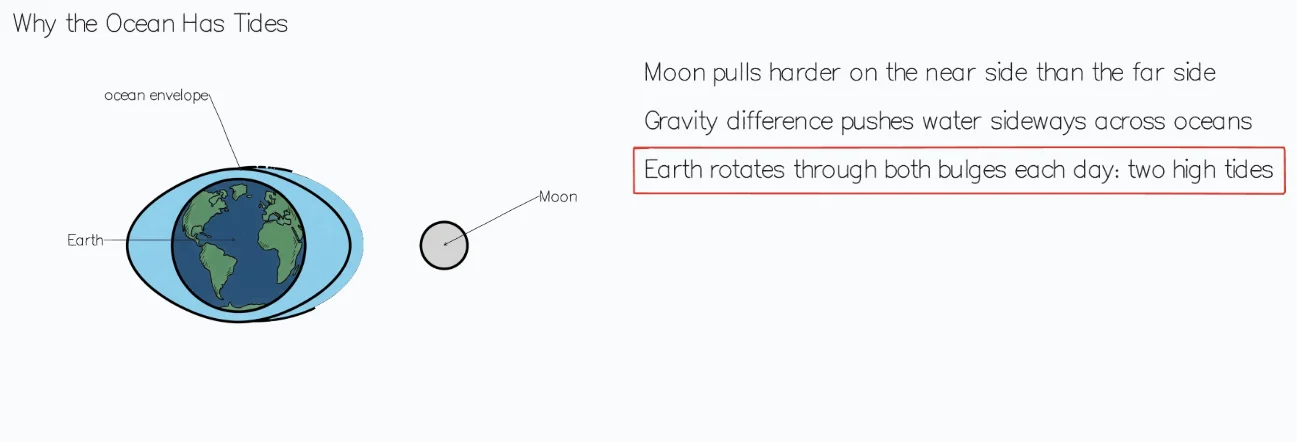
The side of Earth closest to the Moon feels the strongest gravitational tug, while the far side feels the weakest. That difference across thousands of kilometres stretches the planet's water sideways into an oval shape, creating one ocean bulge facing the Moon and another bulge pointing straight away on the opposite side.
People often picture the Moon sucking water straight upward like a magnet, but Earth's own downward gravity is far too strong for that. What actually happens is that the near side of the planet is pulled more firmly toward the Moon than the far side is.
Because gravity pulls unevenly across the planet, water across vast ocean basins gets squeezed and guided sideways along Earth's surface, sliding toward the points of alignment.
That sideways flow piles water up in two places: directly beneath the Moon on the near side, and directly opposite on the far side, where the solid Earth is pulled toward the Moon faster than the far water is.
The bulges stay aligned with the Moon while Earth spins underneath them once every twenty-four hours. As your coastline rotates into a bulge, the sea creeps up the beach for high tide, and as you rotate out into the shallow trough, the water recedes for low tide.
That daily rotation beneath the two bulges is why we see the rhythm of two high tides and two low tides every day.