Lessons · Maths
What is a derivative in calculus?
A lesson drawn by Saitama, the AI tutor that teaches on a whiteboard.
The explanation
Think about driving a car: your trip average might be fifty kilometres per hour, but your speedometer tells you your exact speed right now, at this split second. Calculus calls that instantaneous rate of change the derivative.
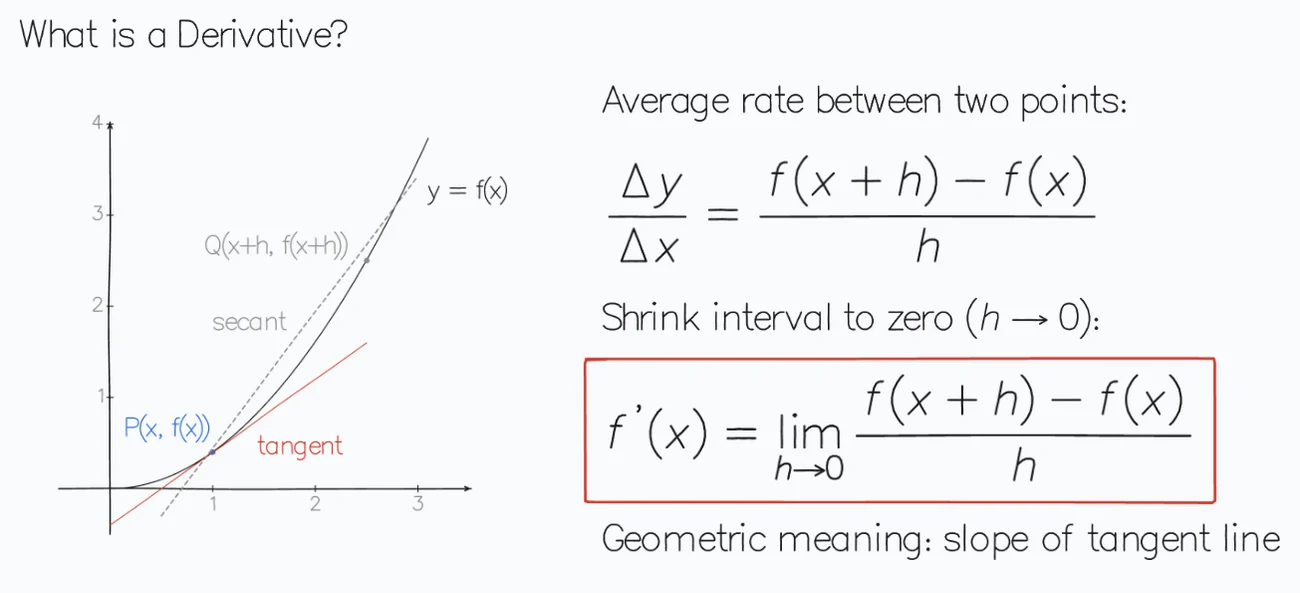
On a graph of a curve, finding speed between two separate times means drawing a straight line between two points and taking its rise over run. But if we slide the second point closer and closer to the first, that chord turns into a tangent line touching the curve at only one exact spot.
Across any gap h, the average rate of change is vertical change divided by horizontal change: f of x plus h minus f of x, all divided by h.
This fraction gives the slope of the grey line across the gap. It is an average over an interval, not the speed at one instant.
To know what happens at the exact point P, we shrink the time gap h until it approaches zero. We cannot divide by zero directly, so we take the limit as h gets infinitely close to zero.
This limit is written as f prime of x. It gives us the derivative: the exact slope of the curve right at that single point.
So whenever you hear derivative, picture the steepness of that red tangent line touching the curve at that exact moment.
That single limit formula is the foundation of differential calculus.